Beloved Husband, Dad and Grandpa • July 8, 1936 – May 24, 2021
“Although it is important to remember the past, don’t let the past rule your life”
~ Peter Heinz Daniels
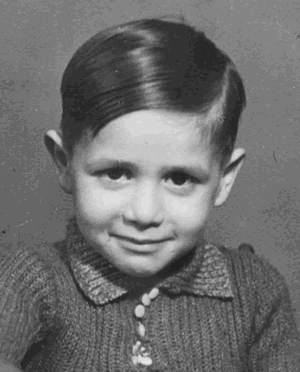
I was born Peter Heinz Berlowitz on July 8, 1936, in Berlin, Germany, three weeks before the Berlin summer Olympics. My mother and I lived within a tram ride to the main sports stadium, where the Nazi party was humiliated when an American Black athlete by the name of Jesse Owens, beat the pants off “superior Aryan” athletes in track and field.
My maternal grandfather, Georg Berlowitz, left Poland in his early 20’s to settle in Berlin, Germany. As a Jew in Poland he had limited opportunities. In Berlin he became moderately successful as an administrator in a large steel company. He also co-founded the Judischer Rudder Club (Jewish Rowing Club), a prominent rowing club on the Wansee Lake just outside of Berlin. This was near to where the infamous Wansee Conference was held in 1942, when the Nazis devised The Final Solution to kill all the Jews.
My maternal grandmother, Hedwig, died in 1912 while giving birth to my mother, Hilde, who subsequently was sent to live with her paternal aunt, Gertrude and her family. When Hilde was 7 years old, her father remarried, this time to Anna, a natural-born Jewish woman with two daughters. A few years later, Hilde returned to live with her father’s new family.
These were very difficult years for Hilde, because her stepmother and stepsisters were very cruel to her. Her father spent a good deal of his day at work and, later, at the rowing club, leaving Hilde at the mercy of her stepmother and two stepsisters.
In 1933, when my mother was 21 years old, Adolf Hitler and the Nazi party came to power in Germany. In September 1935, the Nuremberg laws were passed. Hundreds of thousands of Jews lost their jobs. Jewish doctors were forbidden to treat patients; Jewish lawyers were forbidden to represent clients; Jewish teachers and professors were kicked out of public schools and universities.
Jews were barred from playgrounds, movies, museums, places of entertainment, restaurants, trains, and buses. Jews were not allowed to own pets, radios, automobiles, or to fly the Nazi/German flag.
To earn a living, my mother worked as a housekeeper for well-to-do families.
Amongst her small group of friends was Erich Daniels, the son of a Jewish lawyer. Their brief affair resulted in my birth in 1936. I do not know if he was aware of my existence, because my mother refused to share with me any details about Erich or their relationship. what I do know is that early in 1939, after Kristallnacht, Erich and his family fled from Germany to Shanghai, China; he died there in 1944. Because I was illegitimate, I was not given my father’s family name.
In 1940, when I was 4 years old, the Nuremburg Laws became even more onerous. I was kicked out of my preschool, because I was Jewish. I was not permitted to attend any other public school. Jews were not permitted to work for non-Jews, and vice-versa.
I had to wear a yellow star on my outer clothing, with the word “Jude” (Jew), prominently displayed in the middle of the star. This was the law for all Jews in Germany and was strictly enforced.
My mother was now forbidden to work in a non-Jewish home. Fortunately, she found work as a seamstress in a German army uniform factory. She had a special bus pass which she could use only during the workweek to and from the factory. She left early in the morning and did not return to our apartment until late in the evening.
Since non-Jews were forbidden to work for Jews, and many Jews were attempting to escape Germany, she was unable to find a babysitter for me. She had no choice but to leave me alone in our small apartment, from the age of 4 to the age of 7, while she worked all day in the uniform factory. I was extremely lonely, and became shy and socially inept.
My mother created reading and arithmetic assignments for me, because the German children’s books were full of anti-Jewish propaganda. That was the only education I had until the age of 11.
Since we were not allowed on public transportation, the only outdoor activity was on the weekend when we would walk to the local market for foot. We were permitted to shop only on certain days and only during certain hours. When people saw the yellow star we wore with the word “Jude” on our clothing, they looked at us in disgust and were often rude to us while waiting in line buy food.
Adolph Hitler enjoyed the adoration of crowds and in the early years of the Third Reich, he would often be the center attraction of parades, while waving to enthusiastic supporters. Since we lived near a major boulevard, most of the parade routes were close to where we lived. My mother and I often would be in the crowd watching Hitler wave to his adoring followers. These Hitler-led parades were often filmed for distribution to theatres for propaganda purposes.
In 1941, my maternal grandfather, Georg, died and was buried in the Friedrichstrasse Jewish cemetery. Anna was sent with her daughters to the Lodz ghetto in Poland where they were murdered.
In 1943, when I was 6 years old, most of the Jews in Germany had either been taken to concentration camps, were in hiding, had escaped, were passing themselves off as non-Jews, or were of mixed parentage, known as “mischlinge,” where at least two of their grandparents were not Jewish.
Although Jews of mixed parentage had not yet been deported to concentration camps, the Nuremburg laws applied to all German Jews, regardless of their parentage. My maternal grandmother was born a Christian, but converted to Judaism before marrying my grandfather. My mother had kept her mother’s Christian birth certificate, which she presented to the Nazi authorities as proof of our “mischlinge” status and which allowed us to avoid deportation.
By 1943 Nazi policy towards “mischlinge” changed: every Jew, regardless of parentage or being in a mixed marriage, was deported to a concentration camp.
In June 1943, my mother and I were arrested and taken to a detention center in Berlin while awaiting deportation. The center was in the basement (then being used as bomb shelter) of an empty office building. There were no furniture, beds, chairs, or tables. We slept on the floor and had to bribe guards with our valuables for food and water. We remained there for a few weeks while the roundup of other Jews continued.
One day, while inspecting the detention center, a Nazi official noticed that my skin was jaundice (yellow). He called for a doctor who diagnosed me as having a contagious condition. That Nazi official immediately sent me to a hospital where I was placed in quarantine, in fear that my condition could create an epidemic.
While I was in the hospital, my mother was given permission to go back to our apartment, which gave her an opportunity to take care of personal things she could not do at the time we were arrested. I learned later that the Nazi official who had sent me to quarantine was Adolf Eichmann, who was the overseer of all the concentration camps.
In 1960, Eichmann was captured in Argentina by the Mossad, Israel’s intelligence service. He was found guilty of war crimes in a widely-publicized trial in Israel, and hanged in 1962, the only criminal in Israel to face capital punishment.
A few days after I returned from the hospital, all of the people in the detention center were taken to one of the Berlin train rail yards. We were loaded unto a cattle car and deported to Terezin, a concentration camp in Czechoslovakia, renamed Theresienstadt by the Nazis.
Terezin was built as a military garrison in 1780 for about 5,500 soldiers and their families. Later it was turned into a state prison, and in 1941 the Nazis converted it into a concentration camp. The Nazis called the camp a “ghetto” because the first Jews deported to it were war veterans and the elderly. The illusion was that it would be self-governing, but it soon became clear that the camp was a gateway to the death camps in Poland, including Auschwitz and Buchenwald.
Between 1941 and 1944 some 165,000 Jews were deported to Terezin from the Czech lands, and from Germany, Austria, Holland, Denmark, and Slovakia. Some political and intellectual non-Jews from the Czech lands were also deported to Terezin.
Although a normal train ride from Berlin to Prague would be 5 hours our transport took over 24 hours. We did not have any toilet facilities nor space to lie down in the train. The Germans did not provide us with either food or water and only stopped once or twice for toilet breaks. The only food we had was what we were able to smuggle on board.
The cattle car in which my mother and I were deported was number I-98. Out of the 100 Jews (mothers with babies and children, young and old adults) transported to Terezin, only 32 survived the Holocaust.
We arrived in Terezin’s old train station in the middle of the night, hungry and exhausted. Except for trucking in the elderly and those to weak to walk the distance, the rest of us had to walk two miles to the camp. (The following year the tracks were extended to run inside the camp).
We were sent to the attic of an old barrack to sleep until early the next morning when we were rousted and let to a large open lot to be “processed” into Terezin. We were told to remain standing until our names were called. Eventually the names of my mother and me were called. We were ordered to stand in front of a desk and to hand over all of our possessions to the guards. My little suitcase contained only clothing; the guard kept most of what I had brought with me, leaving me with almost nothing to wear during the two years I spent in Terezin.
The Nazis were notorious thieves, stealing from Jews almost everything they could, including art works, jewelry, silver, gold, real estate, businesses, homes, personal heirlooms, clothing, and so on.
After four hours of enduring this processing, we were assigned to our living facilities. My mother went with other adults to another section of the camp, while other children and I were assigned to the children’s barracks. A week later I turned 7 years old.
I lived in the children’s barracks with hundreds of children younger and older than I. We slept on three-high straw pallets, and with only a thin blanket. Our daily ration was a bowl of watery so-called “soup” made from potato peels, and a small piece of bread, morning and evening.
At great risk, a few of us would sneak out of the barrack in the middle of the night, crawl on our bellies for about 100 yards or so to the railroad siding where rail cars with provisions were waiting to be unloaded the next day. Small potatoes would sometimes fall through flooring unto the tracks, which we eagerly gathered up and cooked on the hot-bellied stove in the barracks.
We washed a few times a month with cold water from spigots connected to a horse trough, and endured very primitive toilet facilities.
Occasionally, the older boys became part of a work party transferring and loading confiscated Jewish property unto trucks heading to Nazi headquarters in Berlin. In 1944, I was growing taller and appeared older than my age, and became part of this group of child workers.
One day, while we were loading small, light, white boxes unto a truck, one of the boxes fell out of our hands, and dropped to the ground. Out dropped a human skull. Very quickly we put the skull back into the box and continued loading the rest of the boxes unto the truck. Luckily, the guard missed this little episode and nothing more came from it.
And for what purpose were these skulls being used? They were sent to German laboratories where scientific researchers “proved” that Jews were inferior to the German “Aryans” by the configuration of their skulls. This was part of the anti-Sematic propaganda the Nazis had elevated to an art form. Today this type of research falls under the category of junk science.
The Jewish elders in Terezin (those who were leaders in their respective communities before deportations) had convinced the camp administrator to allow the children to attend makeshift classes as a way to keep us busy and occupied. However, this was futile because we were too hungry and sick to concentrate for any measure of time.
In June 1944, the International Red Cross and the Danish Red Cross, were invited by Hitler to visit Terezin in order to dispel allegations of his torture and murder of the Jews.
When the invitation was accepted, and to make it appear that there was no overcrowding at Terezin, Hitler ordered 7,500 Terezin Jews to again be shoved into cattle cars. They were shipped to Auschwitz, where they were immediately murdered in the gas chambers and then burned in the ovens.
The Nazis then constructed a Potemkin-type village away from the main camp. A number of prisoners were intimidated into participating in this charade by sipping “coffee” in the “café,” reading books from the “library,” performing musical numbers in the orchestra pavilion, and playing soccer.
A number of the camp children practiced for and presented an opera called Brundibar, which was performed entirely by camp children. It was this sectioned off area phony area of the camp that the Red Cross were directed and where they stayed for 4 hours. The Nazis filmed this charade for propaganda purposes. The Red Cross was enthralled with their inspection and issued a favorable report to the world about the Nazis good treatment of the Jews.
Following the Red Cross inspection, most of the inmates who were forced to go along with the Red Cross farce, as well as most of the children who performed in the Brundibar performance, were deported to Auschwitz and murdered.
At any one time, Terezin had a population between 35,000 and 65,000, crammed into buildings built for 5,500 people. Between November 1941 and October 1944, 88,000 Jews (and some non-Jews) were shipped by cattle trains to the death camps at Auschwitz/Birkenau, Treblinka, and other slave labor camps.
Over 33,000 people died in Theresienstadt of starvation, disease, torture and executions. The crematoria operated 24 hours a day, seven days a week to burn the remains of the thousands who died there.
1.5 Million Jewish children were murdered during the Holocaust. Of this number, 15,000 were sent to Theresienstadt. When the camp was liberated by the Soviet army in May 1945, I was one of less than 100 children still alive in the camp.
The camp commander and a few of the guards had escaped beforehand.
A unit of the Prague Red Cross arrived with food, clothing, and medicine for the surviving inmates, many of whom died shortly afterward.
I received clothing and a pair of shoes, my first change of clothing in over two years. For the first few nights, I wore the new shoes to bed.
After we were released from Theresienstadt, my mother and I returned to Berlin. The city lay in ruins from the massive bombing by the Allied forces and the devastating battle between the Soviet and German armies in which over 80,000 soldiers and civilians were killed.
I was now 9 years old and roamed the streets scavenging for food.
A few months later, we were accepted into a Displaced Persons, or DP refugee camp, in Deggendorf, a town in southern Germany. It was one of many camps for Holocaust survivors run by the American Army. These survivors had been stripped of their homes and all of their worldly possessions by the Nazis and their accomplices, and were now stateless with nowhere to go.
As I had never been to school, my mother enrolled me in the local Deggendorf School. While there, I was subjected to vicious hatred by 8 to 10-year old German children. Although I was only 9 years old and had endured two horrific years in a concentration camp, my classmates were convinced that I was personally responsible for the war that had killed so many of their brothers, fathers, and uncles. I was attacked everyday after school by gangs of schoolchildren who beat me with sticks and rocks. A few weeks later, my mother finally pulled me out of the school.
While in the DP camp my mother married, Max Kurlander, another Holocaust survivor. My half-sister, Evelyn, was born in there in September 1946.
Prior to the Holocaust my mother was very abusive to me, most likely because of her anger at my biological father for having abandoned her in Berlin when he left with his family for Shanghai.
Even after my mother married in the DP camp, I continued to endure constant physical and emotional abuse from her. My mother had endured unbelievable hardships before and during the Holocaust.
She felt grateful that Max had married her, a woman with an illegitimate child, even though my stepfather very quickly began to resent me and stood idly by while I was subjected to daily beatings.
My stepfather was also a broken man who had barely survived the horrors of several concentration camps.
 In August 1947, we finally left Germany for America where we settled in the lower east side of Manhattan. I remember the day we sailed into New York harbor and passed the Statue of Liberty. All of us refugees were on deck crying with joy with anticipation of starting a new life in America.
I was 11 years old.
Unfortunately the physical and emotional abuse I suffered by both parents, continued unabated until I made a final break from their household at age 14, never to step into their home again.
In later years, my mother told me that when I ran away from home, she and Max made no effort to find me. My departure erased a source of friction between them that most likely improved their marriage.
I lived my teenage years as a laborer, farm hand, ranch hand, truck driver, dishwasher, carnival hand, lifeguard, and other forgetful endeavors.
I wound my way across the U.S. a number of times, courtesy of cattle cars (this time by choice), hitchhiking, or Greyhound buses, all the while making sure that I was clean, neat, and courteous, lest I would be mistaken for a derelict or a hobo (which in reality I was). I never put myself in a position that could jeopardize my liberty or personal freedom.
When I was 22 years old, I enlisted in the U.S. Navy and I discharged at 26 with less than 3 years of formal education. I was given the opportunity to become an American citizen and to change my name. I changed my family name from Berlowitz to that of my bio father, Daniels.
Fortunately, I made friends with people who encouraged me to get an education. Seven years later, I had completed high school, graduated from San Diego State University, and received a graduate degree from Thunderbird Graduate School of Global Management. I married and had a son, who I named for my bio father.
I was recruited by an American company with European operations to work in Germany. I spent almost three years traveling on business throughout Europe, from my base in Hamburg, Germany.
I returned to the States, got divorced, and settled in Los Angeles. After a brief second marriage, I divorced again. In 1981, I married Joan, who had 3 children. Today we have a combined family of 4 children (Ilana, Dahn, Erik, Rahm) and 9 grandchildren (Max, Ari(elle), Rose, Russell, Peter, Annika, Axel, Hazel, Micah).
 I worked for 20 years in corporate banking and retired at age 64. It was then that I became involved speaking about the Holocaust and my childhood during the Nazi era, at the Museum of Tolerance.
At age 71, I was recruited by a major financial institution to work as consultant, and remained in that position for two years.
I have been speaking of my Holocaust experiences at schools, synagogues, the Museum of Tolerance, the Los Angeles Museum of the Holocaust, and other venues whenever I am given the opportunity to do so.
I do so because of my conviction that our young people, must carry on the legacy, stories, and lessons of the Holocaust so that its 6 million murdered Jews, and 11 million murdered non-Jews, will never be forgotten.
Downloadable PDF of Peter’s Story
Family note: We will continue sharing Peter’s story so his legacy and the Holocaust will never be forgotten. Peter touched many people throughout the world with his testimony and we were honored to be his family. We love and miss him.
More Information and Article Links
- PDF Download: Peter (Berlowitz) Daniels Q and A Plus Documentation from Germany
- Museum of Tolerance – Peter Heinz Berlowitz
- Jewish Journal – May 1, 2013, Survivor: Peter Daniels
- The Human Element Project – Peter Daniels
- California School News Report – March 11, 2015, 300 Cal High Students Hear Holocaust Survivor’s Story in Skype Session
- Standard Examiner – April 19, 2015, Holocaust survivor relives history with Utah students
- West World – May 4, 2016, West Students Touched by Holocaust Survivor
- Greeley Tribune – May 8, 2016, Holocaust Survivor Shares Story During Observance Week
- Gentleness Wins – April 17, 2019, By Eric Christensen
- Museum of Tolerance – 2020, Becoming a Witness Virtual Exhibition
- Book-How We Survived: 52 Personal Stories by Child Survivors of the Holocaust (link to purchase)
Videos and Video Links
More Videos!
- Museum of Tolerance: A Child Survivor of Theresienstadt-Peter Daniels – goes to Vimeo
- Museum of the Holocaust: Walking Carefully-Peter Daniels– goes to Vimeo
- PBS RE-Dream: Peter Daniels – goes to PBS California
- Holocaust Museum. L.A.: Peter speaks to Students from Hamilton HS 9/18/17 – on Facebook
For More Information & Resources
Return to MAIN PAGE – https://danielsfamilypdx.com/
 Daniels Family